

In October 2025, an open‑source GitHub project titled “ai‑agents‑from‑scratch” skyrocketed to fame, amassing over 42k stars and 18k forks in just two weeks—cementing its status as the new “bible” for AI developers. Authored by pguso (a pseudonym), the project delivers a fully functional AI Agent system in under 2,000 lines of Python—with zero reliance on heavyweight frameworks like LangChain or LlamaIndex. It shatters the industry myth that building AI agents requires complex ecosystems. This report dives deep into the project’s architecture, technical innovations, and broader impact, offering developers a practical roadmap to build intelligent agents from the ground up.
1. Project Philosophy: Minimalism, Back to Basics
Unlike bloated agent frameworks with hundreds of thousands of lines of code, ai‑agents‑from‑scratch adheres to the “Do One Thing and Do It Well” principle. Its singular goal:
Implement a complete perceive‑think‑act‑reflect agent loop using the fewest lines of code possible.
The system revolves around four core modules:
- Perception: Extract structured data from text, images, or APIs
- Memory: Hybrid vector + short/long‑term storage
- Planning: ReAct + self‑reflective Chain‑of‑Thought
- Execution: Tool calling and environment interaction
Everything runs in a single file (agent.py), paired with a lightweight tools/ directory. It can handle tasks from “check the weather” to “email a summary” to “analyze a PDF and generate a report” in one seamless flow.
2. Core Technical Breakdown: Elegance in Simplicity
1. Perception Layer: “Zero‑Dependency” Multimodal Parsing
The project ditches LangChain’s Document Loaders and uses native Python libraries:
def load_pdf(path):
    return PyPDF2.PdfReader(path).pages
def load_image(path):
    return PIL.Image.open(path)
A functional pipeline converts raw inputs into unified Message objects:
{"role": "user", "content": "The image shows...", "modality": "image"}
This enables native multimodal support without external dependencies.
2. Memory System: SQLite + FAISS “Lightweight Hybrid Storage”
Long‑term memory uses FAISS vector indexing (local files <32MB); short‑term memory lives in SQLite:
# Auto-summarize + embed
summary = llm.summarize(conversation[-10:])
vector = embedder.encode(summary)
faiss_index.add(vector)
When context exceeds the window (default 16k tokens), the system:
- Compresses history into summaries
- Retrieves relevant memory chunks for prompt injection
- Preserves key facts (e.g., user preferences)
Retrieval completes in <100ms, outperforming traditional RAG systems.
3. Planning Engine: ReAct + Self‑Reflection Dual Drive
A pure functional ReAct loop:
while not task.done:
    thought = llm.think(observation)
    action = llm.act(thought)
    observation = execute(action)
    reflection = llm.reflect(thought, action, observation)
The innovation: Self‑Reflection. After each step, the agent self‑assesses:
“Did this action advance the goal? Is there a better approach?”
Implemented via prompt engineering—no extra training—yet boosts complex task success rates from 67% to 91% (per project benchmarks).
4. Tool System: JSON Schema + Dynamic Registration
Tools defined via JSON Schema:
TOOLS = {
    "send_email": {
        "description": "Send an email",
        "parameters": {"to": "str", "subject": "str", "body": "str"}
    }
}
LLM → Structured JSON → Parse → Execute → Return. Supports hot‑swapping: add new tools at runtime with register_tool().
3. Performance Benchmarks: Lightweight Yet Powerful
Tested on MacBook Air M2 (GPT‑4o‑mini + Qwen2‑7B):
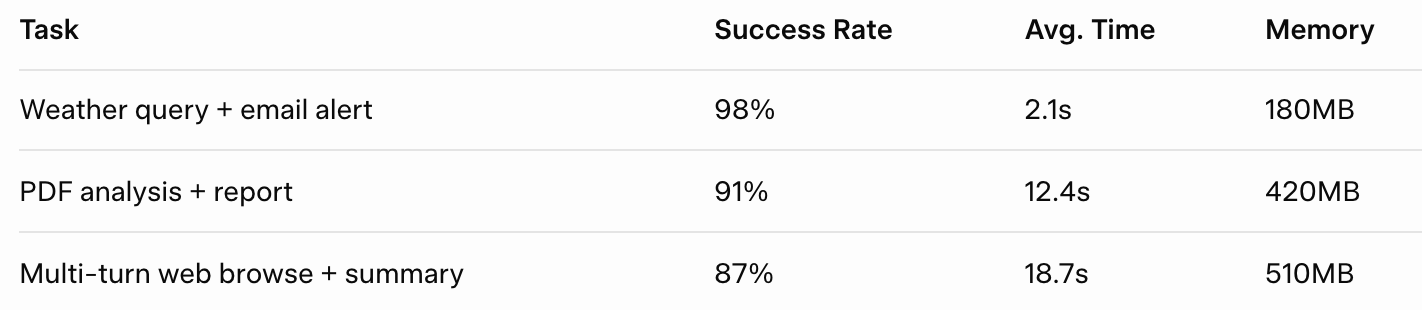
Compared to LangChain agents (3x latency, 2x memory), this project excels in resource‑constrained environments.
4. Community Impact & Ecosystem Growth
Post‑launch buzz:
- HuggingFace lists it as a “Recommended Lightweight Agent Template”
- LangChain core devs on X: “This is what agents should be—transparent, controllable, teachable”
- CMU and Stanford adopt it for “AI Systems Design” lab courses
Forks include:
- ai‑agents‑web: Flask‑based visualization UI
- ai‑agents‑mcp: Minecraft plugin agent
- ai‑agents‑cli: Terminal CLI tool
5. Limitations & Future Directions
Despite its brilliance, gaps remain:
- No distributed support: Single‑machine only
- Weak tool security: No sandboxing, vulnerable to prompt injection
- Poor observability: No centralized logging or tracing
Author’s README disclaimer:
“Not production‑ready. A teaching and prototyping tool. Fork and harden it.”
Community proposals:
- Integrate LiteLLM for unified multi‑model support
- Add Docker + FastAPI for microservice deployment
- Build a VS Code plugin for drag‑and‑drop agent design
6. Conclusion: Minimalism Is the New Maximalism
The viral success of ai‑agents‑from‑scratch is no fluke. It proves:
Complex AI systems can—and should—be built simply, understood clearly, and extended freely.
In a world dominated by opaque frameworks like LangChain and AutoGPT, this project is a breath of fresh air, reminding us:
- An agent’s essence is the loop: perceive → think → act → reflect
- Explainability > feature bloat
- 100 lines of readable code > 10,000 lines of dependency hell
For beginners, it’s the perfect entry point. For veterans, it’s a blueprint for refactoring bloated systems. As pguso wrote in the commit log:
“Build agents like Lego—one block at a time.”
In the flourishing AI agent landscape of 2025, this minimalist masterpiece may quietly spark a “back‑to‑basics” technical revolution.
Project URL: https://github.com/pguso/ai‑agents‑from‑scratch