
2025 is being called the inaugural year of AI Agents and they are receiving growing attention. This article aims to provide a systematic explanation—fromdefinition, role, and core components, tothe relationship with the MCP Server—so readers gain a clear perspective on understanding them.
1. What is an AI Agent?
An AI Agent is, simply put, an AI system capable of "autonomously understanding, deciding, and executing tasks."
It is not just a language model that passively answers questions, but an active agent with the following characteristics:
- Goal Understanding
- Can comprehend user intent rather than merely responding to text input.
- Autonomous Reasoning
- Can plan task steps on its own (e.g., using ReAct or Plan‑Act frameworks).
- Tool Use & Environment Interaction
- Can use APIs, databases, file systems, and even robotic devices.
- Memory & Reflection
- Can retain historical information, review past decisions, and improve.
- Persistent Execution
- Can run for extended periods rather than only supporting one‑off conversations (e.g., AutoGPT, OpenDevin).
2. The Role of AI Agents
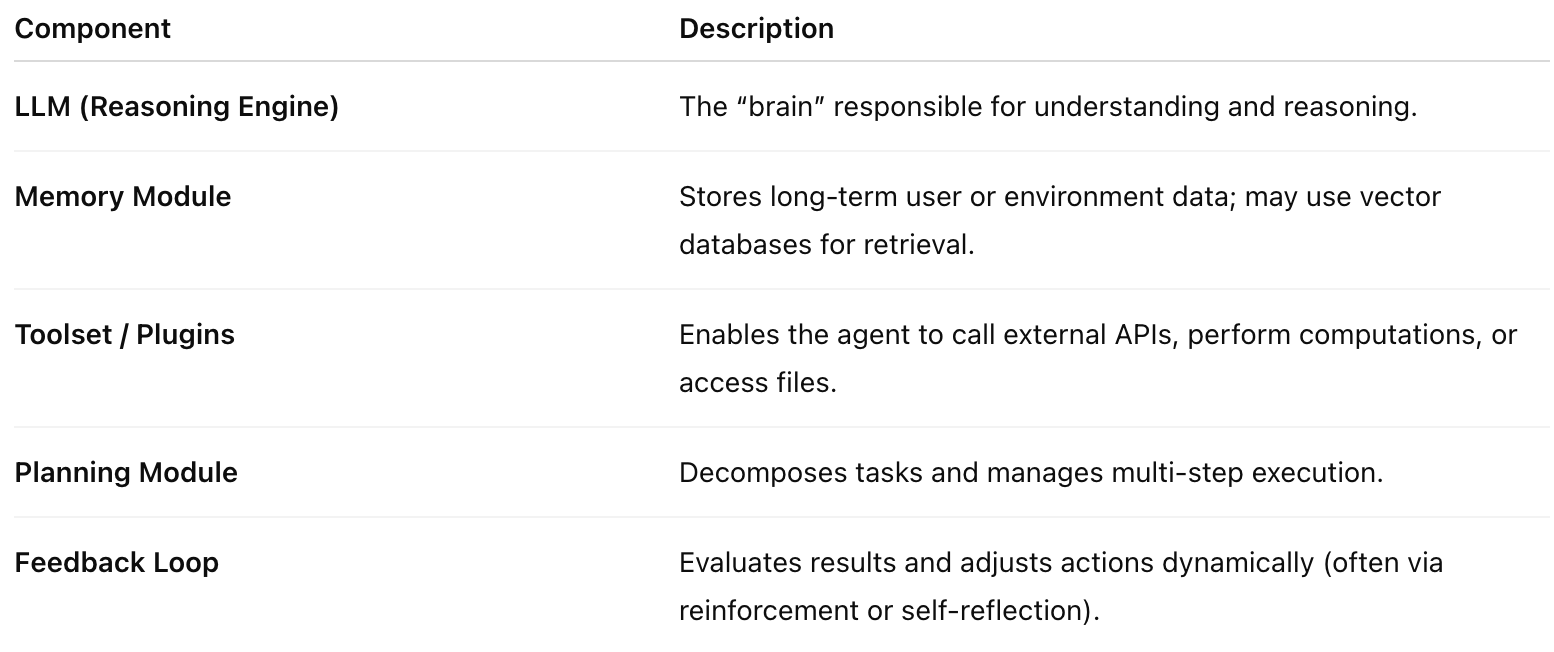
In short: an LLM is the brain; an Agent is the brain plus a body.
3. Main Components of an AI Agent
Modern AI Agents typically consist of the following five core parts (also the basic design of frameworks such as LangChain, LlamaIndex, CrewAI):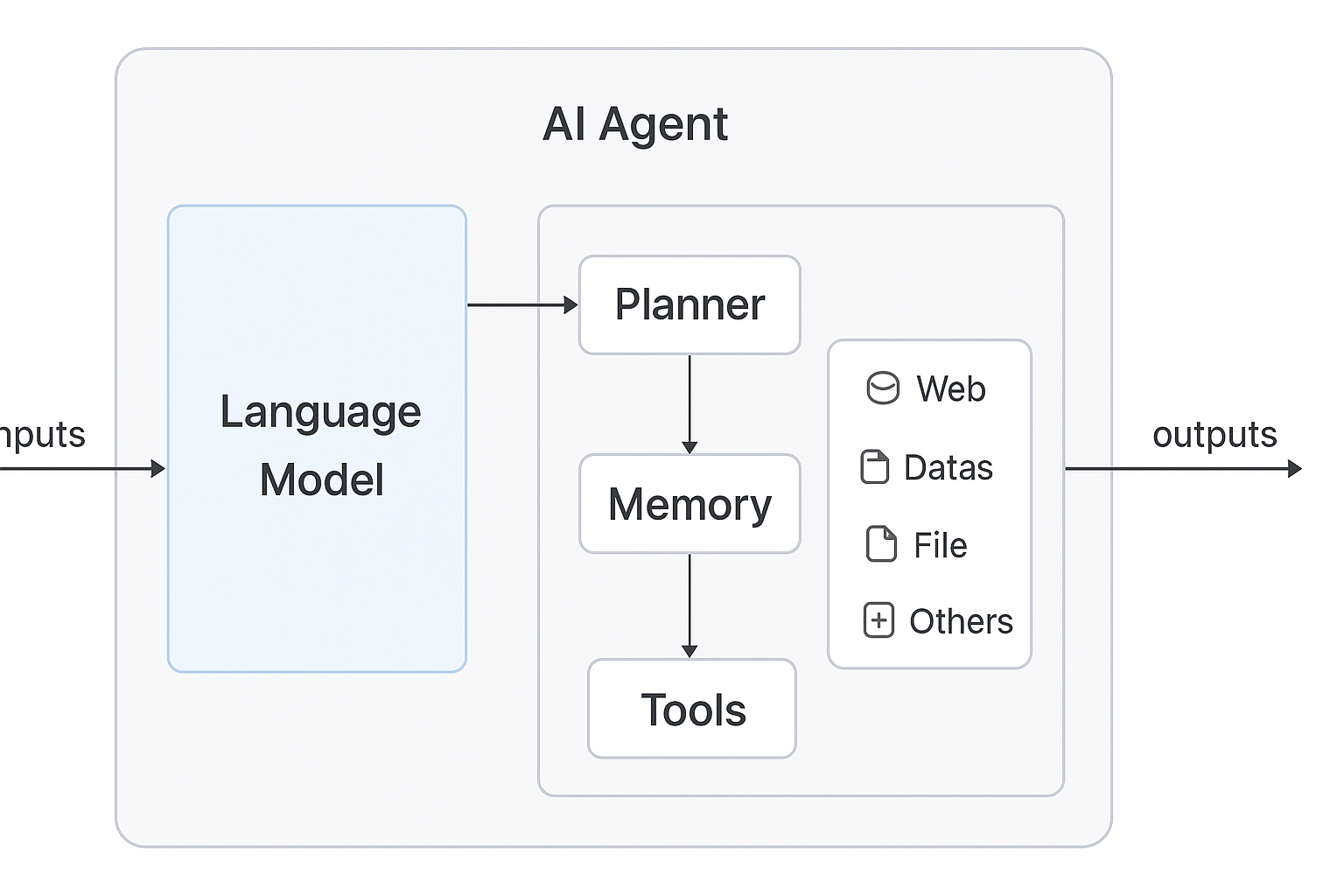
1️⃣ Language Model (LLM)
The intelligence core responsible for understanding tasks, reasoning, and generating instructions.
Common models: GPT‑4, Claude 3, Gemini, DeepSeek‑V2, Mistral, etc.
2️⃣ Memory
Stores conversation history, task context, and long‑term knowledge.
Common forms:
- Short‑term memory: session cache;
- Long‑term memory: vector databases (e.g., Pinecone, MongoDB Atlas Vector Search).
3️⃣ Tools / Actions
Agents can call external systems via function calls:
- Browser / web search;
- Databases / APIs;
- Shell commands;
- File systems;
- Other agents.
(In the OpenAI ecosystem this is referred to as “Function calling” or “Actions”.)
4️⃣ Planner
Decomposes complex tasks into multiple steps (task decomposition);
Can use algorithms like ReAct, Tree‑of‑Thought, Graph‑of‑Thought, etc.
5️⃣ Environment
The context in which the Agent runs (it can be the Web, CLI, IDE, or enterprise systems).
This is the Agent’s “interface layer” for perceiving the external world.
4. MCP Server and AI Agents
MCP (Model Context Protocol) is a new standard protocol proposed by Anthropic at the end of 2024 for communication between LLMs and external systems. Its main purpose is to allow large language models (LLMs) to access external tools, data sources and contextual information in a standardized way. It defines a communication protocol that enables models to dynamically call local or remote resources when executing tasks, such as databases, APIs, documents, and code execution environments.
You can think of it like this:
The MCP Server is a standardized "plugin communication protocol".
It defines interfaces between agents and external systems, such as:
- File read/write (
fsserver) - HTTP requests (
httpserver) - Shell command execution (
shellserver) - Custom API calls (
customserver)
For example:
npx @modelcontextprotocol/server-http
lets an Agent access the internet via the MCP protocol without exposing API keys.
✅ Core purposes:
- Allow agents to "access the world" (data, APIs, systems) in a human‑like way
- Provide a secure, controllable tool‑invocation layer
- Be compatible with different LLMs (GPT, Claude, Gemini, DeepSeek, etc.)
5. Typical Agent + MCP Workflow
- User inputs a task:
"Help me find the open‑source repository for DeepSeek's latest model and summarize its main features."
- The LLM (Agent brain) understands the task → generates a plan:
- Call web search;
- Retrieve repository information;
- Analyze the README;
- Produce a report.
- The MCP Server provides the tools layer:
mcp_http→ execute web requests;mcp_fs→ read temporary files;mcp_shell→ invoke commands.- The Agent aggregates results → outputs a natural language report.
6. Conclusion: Future Directions for Agents and MCP
AI Agents are rapidly becoming the foundation for next‑generation AI ecosystems.
Trends include:
- Contextual intelligence (integrating private data securely)
- Autonomous collaboration among multiple agents
- Standardization through MCP, function‑calling, and API schemas
- Enterprise integration with workflows and production systems
🔹In one sentence:
LLMs are the brain, Agents are the brain plus an action system, and MCP is the communication protocol between Agents and the world.