
As artificial intelligence advances rapidly, global AI governance has become a focal issue for the international community. Recently, the arXiv preprint server published a major research report: "AI Governance InternationaL Evaluation Index (AGILE Index) 2025" (arXiv:2507.11546). The index systematically assesses the AI governance capabilities of 40 countries, covering policy formulation, legal frameworks, risk management and multiple other dimensions. Its introduction not only provides a data‑driven baseline for national AI regulation but also highlights fragmentation and urgency in global AI governance. Report author Cunqing Huangfu (黄福存庆) noted that AI governance accelerated in 2024, with strengthened multilateral frameworks and frequent national regulatory initiatives, but a lack of comparable assessment tools — a gap the AGILE Index fills. The report quickly sparked debate after publication: China ranks among the top five overall, indicating momentum in its shift from a "technology power" toward a "governance power." Experts say the index acts as a "global mirror of AI governance," helping countries identify shortcomings and promote sustainable innovation.
The AGILE Index originated in 2023 and was initiated by an international AI governance research team. The first edition, released in February 2024, evaluated 14 countries and established an initial framework. The 2025 edition expanded significantly to include 40 countries across high‑, middle‑ and low‑income groups, as well as nations at different regional and technological development stages. This expansion reflects the global nature of AI governance challenges: from ethical risk management in developed countries to digital divide issues in developing countries. The report emphasizes that the AGILE Index integrates multi‑source data — including policy documents, governance practices, research output and exposure to risk — to construct a unified comparative framework that helps countries identify governance strengths, gaps and systemic constraints. Huangfu writes in the abstract: "Through continuous iteration, we hope the AGILE Index can fundamentally advance transparency and measurability in global AI governance, provide data‑driven assessments, map national AI governance capability, and offer actionable insights for governments to identify maturity stages and critical issues to ultimately improve national and global AI governance systems." This vision comes as AI regulatory competition intensifies among China, the US and Europe, making the index a timely new variable in international dialogue.
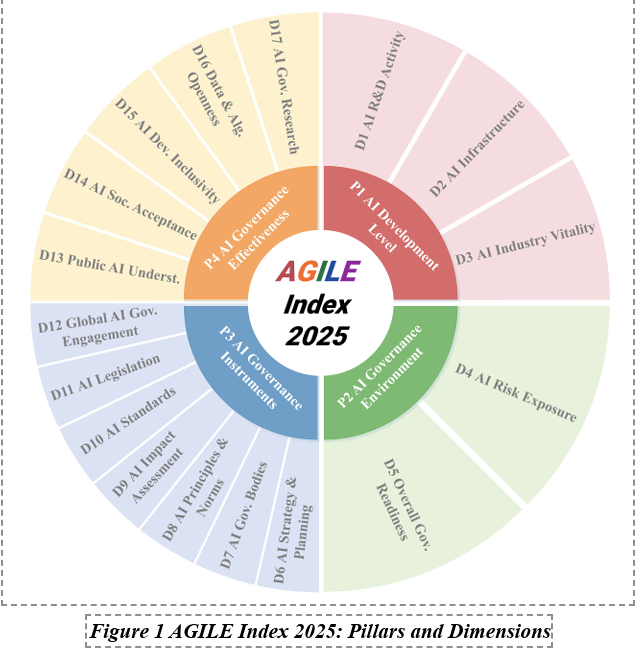
The index's methodology is the foundation of its scientific credibility. The 2025 edition systematically refines the first edition by expanding data diversity and improving indicator validity and cross‑country comparability. The assessment framework comprises 4 pillars, 17 dimensions and 43 indicators, scored on a 100‑point weighted scale. Pillar 1, "Policy and Strategy," evaluates the completeness and executability of national AI development strategies, such as whether a national‑level AI plan exists. Pillar 2, "Law and Regulation," assesses the robustness of data privacy laws, algorithmic transparency and intellectual property protections. Pillar 3, "Risk Management," focuses on ethical review, bias mitigation and security assessment mechanisms. Pillar 4, "International Cooperation and Innovation," measures cross‑border data flows, participation in standards setting and R&D investment. Each dimension contains specific indicators; for example, the risk management dimension includes "classification of high‑risk AI applications" and "emergency response mechanisms," scored using a mix of quantitative measures (e.g., number of laws) and qualitative case analyses. The report applies fractional counting to avoid co‑authorship bias and ensure fairness. Data sources are diverse: policy databases (such as the OECD AI Policy Observatory), academic output (such as arXiv papers) and risk reports (such as UN AI governance guidance). While the methodology is rigorous, the report acknowledges that subjective indicators (like implementation effectiveness) may carry cultural biases and plans to introduce AI‑assisted audits to enhance objectivity in the future.
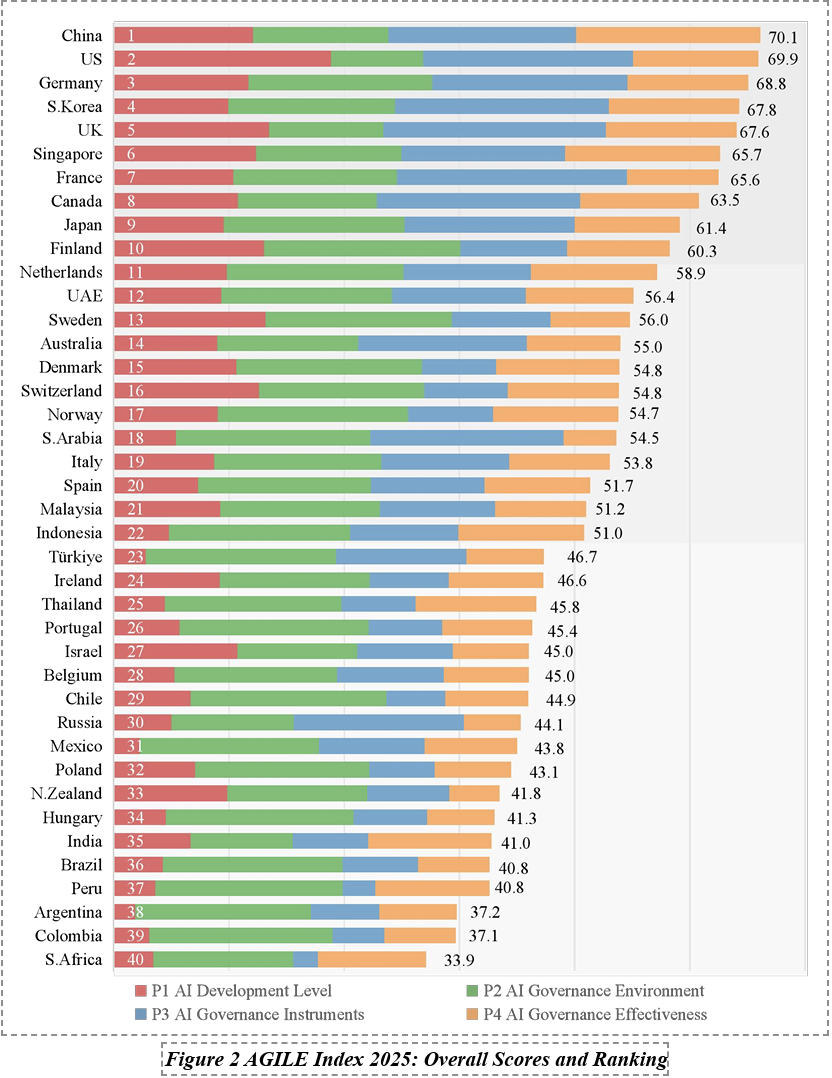
After aggregating the indicators, the final results are as follows: China scored 70.1 to secure first place, ahead of the United States by 0.2 points, underscoring its advantage in "comprehensive balance" in AI governance. Pillar 1 (35.2 points) is the standout, attributed to initiatives such as the "East Data West Computing" project and AI R&D investment (reported to exceed 500 billion yuan in 2025), with patent output accounting for 40% of the global total. Pillar 2 (17.5 points) reflects the strategic depth of the "New Generation Artificial Intelligence Development Plan," though international cooperation (for example, US–China AI dialogues) still has room to improve. Pillar 3 (8.9 points) and Pillar 4 (8.5 points) are relative weaknesses: the Personal Information Protection Law and the Regulations on Algorithmic Recommendation Management provide an initial framework, but implementation effectiveness needs stronger risk assessment mechanisms (such as high‑risk AI classification). In section 5.1 of the report, Huangfu analyzes: "The Chinese model emphasizes a policy‑innovation closed loop; the high Pillar 1 score drives overall leadership, but Pillar 4 effectiveness could benefit from adopting the EU's tiered regulatory approach."
The global landscape shows "multipolarization": Asian countries occupy half of the top 10 (China, South Korea, Singapore, Japan, Malaysia), with a median score above 65, driven by national strategies. European and American countries (such as the United States, Germany and France) are strong in Pillars 1 and 2 but fragmented in Pillars 3 and 4 (the US Pillar 3 score is only 7.2, reflecting federal‑state regulatory conflicts). Emerging markets (such as India and Brazil) score below 42 overall, with weak Pillar 1 infrastructure and a need for international assistance. The report visualizes this in a heat map (Figure 3): high‑income countries average 78 points while low‑income countries average 52, highlighting a "North–South gap." The v2 update improved data diversity by incorporating mid‑2025 risk events (such as deepfake incidents) but did not change core rankings.
The key findings reveal deep trends in global AI governance. First, policy implementation is the biggest bottleneck: among the 40 countries, only 25% score over 80 in Pillar 1, as many countries have plans but lack funding for execution. Second, risk management is a major pain point: regulatory coverage for high‑risk AI (such as facial recognition) is only 60% on average and lower in developing countries, raising potential human rights concerns. Third, international cooperation is a bright spot: coordination among China, the US and Europe within G7 and UN frameworks has improved global standardization, but geopolitical tensions (such as chip export controls) drag down scores. The report presents 29 charts and 7 tables to visualize these insights; for example, a pillar score heat map shows China highlighted in green for "innovation–risk balance," while the United States is shown in orange for the "privacy vs. innovation" trade‑off. Huangfu concludes: "AGILE Index 2025 maps global differences and provides countries with an action roadmap. Through transparent assessment, we can accelerate the transition of AI governance from fragmentation to coordination." This conclusion aligns with UN AI governance reporting, emphasizing the need for data‑driven assessment.
The global impact of the AGILE Index is far‑reaching. It provides policymakers with a diagnostic tool: China could learn from the EU's risk‑tiering to improve international cooperation scores; the United States needs to strengthen a federal privacy framework to bridge interstate gaps. For companies, the index aids risk assessment: tech giants such as Alibaba and Google can adjust global compliance strategies to avoid regulatory fines. The report predicts that by 2030, AI governance scores will correlate with economic output and that high‑scoring countries may see GDP growth higher by about 1.5 percentage points. Under the Belt and Road framework, China could export governance experience to help partner countries raise their scores. Limitations remain: the 43 indicators are comprehensive but do not cover emerging risks such as AI militarization, and data lag may affect real‑time relevance. The project plans to expand to 60 countries and incorporate AI ethics audits and public participation indicators in future editions.
The release of AGILE Index 2025 coincides with a peak in global AI regulatory activity: the EU AI Act is being implemented, US executive orders are updated, and China's draft AI law is under consultation. The index is not only a "thermometer" but also a "navigation tool," guiding AI from unchecked growth to orderly prosperity. Huangfu noted in the arXiv submission remark: "In the AI era, governance is the guardian of innovation." China's rise in the rankings signals determination to "overtake on the curve," but global collaboration remains the path to shared gains. Looking ahead to the 2026 edition, the index could become an "Oscars" for AI governance, incentivizing countries to compete for "best governance." In this process, Chinese approaches to AI governance may contribute additional solutions to the world.
Paper link: AI Governance InternationaL Evaluation Index (AGILE Index) 2025