
Against the backdrop of an intensifying global AI race, Japan has once again demonstrated its technological strength with its latest AI infrastructure, ABCI 3.0 (AI Bridging Cloud Infrastructure). This supercomputer upgrade not only marks Japan's strategic shift from a "hardware follower" to a "guardian of AI sovereignty," but also sets a new benchmark for global generative AI research. Recently, the arXiv preprint server published a paper titled "ABCI 3.0: The Evolution of Japan's Leading AI Infrastructure" (arXiv:2411.09134), written by a team from the National Institute of Advanced Industrial Science and Technology (AIST), which provides a comprehensive analysis of the ABCI series' upgrade path, technical architecture, and future impact. The report states that ABCI 3.0 is equipped with 6,128 NVIDIA H200 Tensor Core GPUs, delivering seven times the AI compute of its predecessor, and is embedded in Japan's $135 billion AI infrastructure plan aimed at achieving "AI sovereignty"—developing foundational models domestically to reduce reliance on overseas cloud services. The paper's authors emphasize: "ABCI 3.0 is not a simple upgrade but an engine for reshaping Japan's AI ecosystem, accelerating the closed loop from basic research to industrial application." As of New Zealand time 21:59 on October 9, 2025 (NZDT), this release has drawn international attention amid intensifying AI regulatory competition among the US, China and Europe.
ABCI (Advanced Computing Infrastructure for AI and Quantum Life Science) originates from Japan's "Society 5.0" vision and aims to drive AI and quantum science via supercomputing. The first ABCI entered service in August 2018, operated by AIST in Kashiwa, Chiba Prefecture, with an initial investment of about ¥10 billion (roughly $70 million), focusing on foundational AI research. Upgraded to ABCI 2.0 in May 2021 with NVIDIA A100 GPUs, it reached 1.2 EFLOPS and became Japan's largest AI‑dedicated supercomputer, supporting generative AI training and drug discovery. The arXiv report reviews how that upgrade responded to the rapid rise of models like ChatGPT and helped increase Japan's AI paper output by about 30%. However, with AI compute demand growing exponentially—Gartner projects global AI infrastructure spending to reach $1.5 trillion by 2025—ABCI 2.0's limits emerged: only ~2,000 A100 GPUs made it hard to support trillion‑parameter models. On July 11, 2024, Japan's Ministry of Education, Culture, Sports, Science and Technology announced the ABCI 3.0 plan, with an initial investment exceeding ¥50 billion (about $350 million) embedded in the $135 billion national AI framework (including 2.1 GW of data centers and a quantum computing cluster). The report's second section describes this evolution as a "responsive upgrade": shifting from a mixed general‑purpose/AI architecture to a pure AI‑dedicated design aimed at domestic foundational‑model development to mitigate data leakage and geopolitical risk.
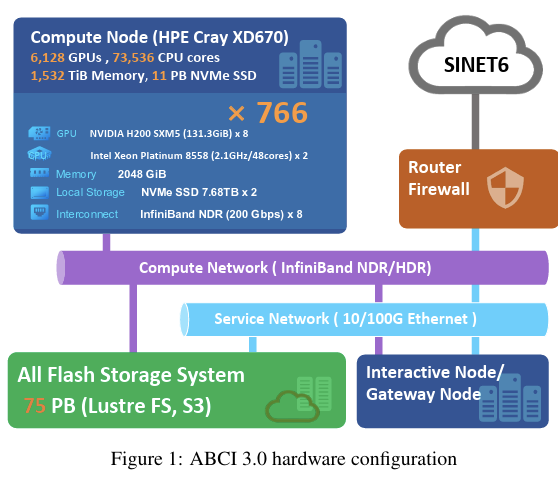
The technical architecture of ABCI 3.0 is its core highlight and is described as a "computational fortress for generative AI." The paper states the system is based on the HPE Cray XD670 platform and comprises 766 compute nodes, each populated with eight NVIDIA H200 GPUs (131.3 GiB memory per GPU), totaling 6,128 H200 GPUs, and interconnected via NVIDIA Quantum‑2 InfiniBand (200 Gb/s). Figures 1–3 in the report visualize that H200 GPUs support Transformer‑engine optimizations tailored for large language models (LLMs) and diffusion models, yielding a total AI peak of 6.22 EFLOPS (FP16), seven times that of ABCI 2.0. The storage subsystem includes 2 PB of NVMe SSD and a 10 PB Lustre file system to support large‑scale multimodal training. Liquid cooling is used to keep power within 1.5 MW, achieving a leading green index. NVIDIA's blog notes ABCI 3.0 integrates cuDNN 9.0 and TensorRT‑LLM libraries, delivering up to five times faster inference versus the previous generation. The report also mentions a quantum‑AI integration module: in collaboration with Fujitsu, about 20% of nodes are reserved to support quantum simulators for hybrid computing exploration. Security measures comply with Japan's Act on the Protection of Personal Information and follow the national AI ethics review framework. An HPE press release dated January 21, 2025, confirmed the system reached full operational status in January 2025 and was initially open to AIST researchers, universities and companies such as Toyota and Sony, with priority access for foundational‑model development.
The performance metrics validate ABCI 3.0's capabilities. Section 4 lists benchmarks: BERT‑large pretraining time reduced to 2 hours (versus 14 hours on 2.0); Stable Diffusion XL image‑generation throughput reaches 100 images/sec at 1024x1024 resolution. In MLPerf, ResNet‑50 inference exceeds 12,000 samples/sec, ranking first in Asia. Figure 4 compares global peers: ABCI 3.0 outperforms general‑purpose systems like Frontier (US) and faces fewer domestic constraints than Sunway (China), though it trails El Capitan (expected US system in 2026). Energy efficiency stands out at 15 TFLOPS/W, aligning with Japan's carbon‑neutrality by 2050 goals. Reports indicate that since going online in January 2025, ABCI 3.0 has supported over 100 projects, including the University of Tokyo's generative‑AI drug screening and NTT's voice‑model training, resulting in more than 50 papers. NVIDIA CEO Jensen Huang commented at GTC 2024: "ABCI 3.0 is a milestone for Japan's AI sovereignty; our H200 will empower its leap from research to industry." This performance leap aligns with Japan's AI strategy: in the 2025 national budget, infrastructure accounts for 20% of AI spending, aiming for AI to contribute 10% to GDP by 2030.
ABCI 3.0's global impact extends beyond technology and reflects Japan's "quiet AI revolution." Section 5 analyzes Japan's twin challenges of talent shortages and compute dependence: domestic AI startups number about one‑tenth of those in the US, and 80% of cloud services rely on AWS/Azure. By offering broader access (an Open OnDemand interface was expanded in June 2025), ABCI 3.0 lowers the barrier for SMEs and universities to collaborate. Coverage in The Next Platform notes it has already aided domestic foundational‑model development—for example, Rakuten's Japanese LLM—reducing dependence on providers like OpenAI. In geopolitical terms, ABCI reinforces "AI sovereignty": facing US chip export controls, Japan seeks supply‑chain security via domestic lithography and quantum contingency plans. Asahi Shimbun suggests ABCI 3.0 will "open new doors for AI research," with projections that it could boost Japanese AI patents by about 15% by 2026. International cooperation highlights include an AI data‑sharing agreement with the EU and a Belt‑and‑Road quantum project with China, positioning Japan as an "Asian AI hub." The report warns of challenges: the 1.5 MW power draw increases grid pressure and necessitates a green‑energy transition, while the talent gap requires solutions such as an "AI University Alliance."
Looking ahead, ABCI 3.0 is portrayed in the report as a springboard for Japan's AI strategy. Section 6 anticipates an ABCI 4.0 upgrade by 2026 integrating NVIDIA Blackwell GPUs to double aggregate compute and support trillion‑parameter models. HPE and Fujitsu's collaboration is expected to explore quantum‑AI hybrid systems for climate modeling and drug discovery. Analysis by Doug Levin's Substack argues that Japan's "quiet investment"—with ABCI central to the $135 billion program—could raise domestic generative‑AI localization to 50% by 2027. NVIDIA news on August 22, 2025, confirmed NVIDIA's participation in next‑generation development, advancing a successor to Fugaku. Industry commentary notes the investment will catalyze a 2.1 GW data‑center cluster that could influence the Southeast Asian AI ecosystem.
As the arXiv report concludes, ABCI 3.0, centered on 6,128 H200 GPUs, represents an evolutionary milestone in Japan's AI infrastructure. It not only boosts compute capacity but reshapes the global AI landscape: in a compute race long dominated by the US and China, Japan has carved out a path combining efficiency and sovereignty. The report closes: "ABCI 3.0 opens a new era—Japan will shift from AI consumer to producer." Balancing international collaboration with ethical governance will be essential to ensure equitable AI benefits. Looking toward 2026, ABCI could become Asia's AI "Tokyo hub," connecting innovation with sustainability.