
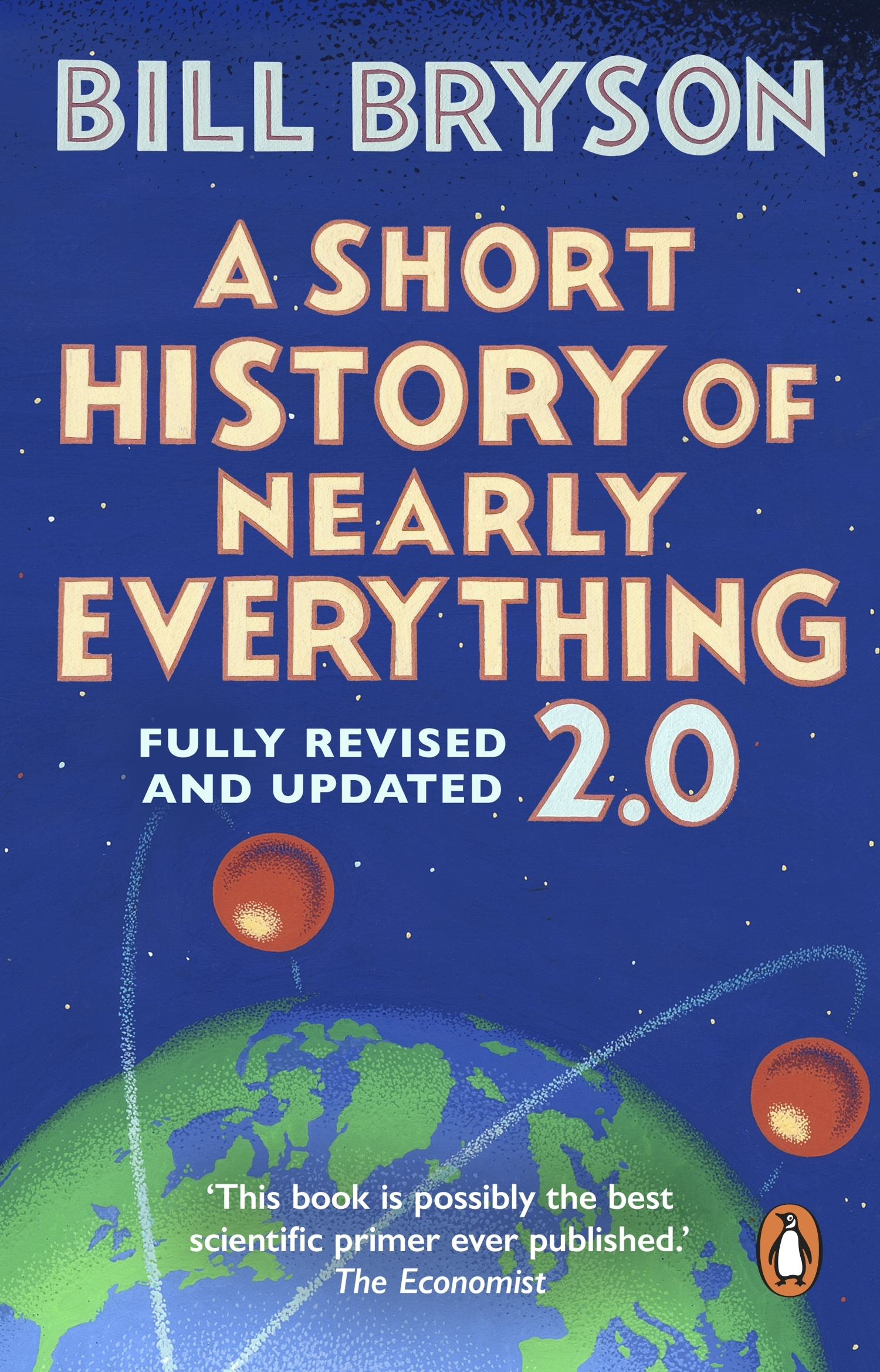
In the realm of popular science reading, Bill Bryson’s A Short History of Nearly Everything has long been an undisputed masterpiece. Since its first publication in 2003, the book’s witty narrative, wide‑ranging and profound scientific perspective have won over tens of millions of readers worldwide, making it one of the best‑selling popular science books of the 21st century. It has won awards such as the Aventis Science Book Prize and the Descartes Prize and has been hailed as a “modern classic of science writing.” Now, in 2025, Bryson has personally overseen a comprehensive revision: A Short History of Nearly Everything 2.0 (A Short History of Nearly Everything 2.0). The new edition was officially published on October 21, 2025 by Penguin and Doubleday, incorporating major scientific advances from the past two decades and giving the timeless classic a fresh vitality. This is truly a work worth cherishing and rereading—whether you are a science enthusiast, a student, a parent, or simply someone curious about the world, it comes highly recommended.
Why is this book so worth recommending?
First, Bryson’s writing style is unique. He is not a professional scientist, yet he acts like a wise and humorous guide, leading readers through the grandeur of the cosmos and the wonders of the microscopic world. From the Big Bang to the formation of Earth, the origin of life to human civilization, he turns complex and dry scientific concepts into vivid and entertaining stories. The original edition’s anecdotes about scientists and the twists and coincidences behind discoveries have made countless readers laugh and reflect. The new edition preserves this core charm. In an interview with New Scientist, Bryson said he hoped the book would “serve readers for another 20 years,” so he personally revised it to ensure the content aligns with current scientific frontiers. This warm, highly readable narration makes science feel close, like a conversation. Many readers on Goodreads and Reddit wrote: “This book changed my outlook and made me fall in love with science!”
Second, the scope of the 2.0 update goes far beyond simple patchwork. It fully reflects the leaps in science since 2003, so returning readers will find it like a new book, and new readers will be exposed to the latest knowledge. Bryson emphasized that scientific knowledge evolves rapidly and parts of the original had become “awkwardly out of date,” so he re‑examined every chapter and incorporated the latest discoveries. Publishers describe this as a “completely revised and updated edition,” not a lazy work with mere footnotes. Wikipedia also confirms that the second edition published at the end of 2025 contains extensive revisions to all chapters.
Key updates in detail: a vivid portrait of 20 years of scientific progress
The core value of the new edition lies in these timely updates, which let readers feel the dynamism and humility of science. Here are several highlights:
In astronomy, the original descriptions of the solar system are now out of date. Over the past 20 years, probes and telescopes have doubled the number of known moons in the solar system—rising from a few dozen to more than twice that number, many of them small icy‑rock bodies. Bryson humorously likens the solar system’s transformation from an “ordered family” to a “surprising emporium.” The most famed change is Pluto’s “demotion”: reclassified from one of the nine planets to a dwarf planet following revised criteria by the International Astronomical Union. The new edition explains this change in detail, reminding readers of the evolving nature of scientific definitions.
The particle physics section adds the discovery of the Higgs boson. This fundamental particle, dubbed the “God particle,” was confirmed in 2012 at the Large Hadron Collider in Europe; it explains why particles have mass and reshaped the Standard Model. Bryson vividly describes how this breakthrough “changed the landscape of physics,” while stressing that 95% of the universe is still composed of dark matter and dark energy—about which we know very little. These updates not only refresh knowledge but convey the excitement and mystery of scientific inquiry.
The chapters on human evolution and biology receive the richest updates. Where the original edition depicted a relatively linear human family tree, modern DNA techniques have revealed many more archaic human species, such as Denisovans and the so‑called “hobbits” (Homo floresiensis). These findings show extensive interbreeding among early human groups, turning the family tree from a single trunk into a dense thicket. In addition, global average life expectancy noted in the original (about 74.2 years) has risen to roughly 80 years, reflecting medical progress. Bryson also expands the discussion of the millions of unknown species on Earth, emphasizing the mystery of biodiversity.
Other fields—geology, chemistry and climate science—also incorporate updated perspectives, such as modern understanding of human impact on Earth’s climate and current views on natural disasters. These updates are woven seamlessly into the original narrative while preserving Bryson’s humor—often poking fun at scientists’ quirks or the serendipity of discoveries.
Who is this book for? What is its reading value?
A Short History of Nearly Everything 2.0 is suitable for readers of all ages. For adolescents it is an excellent science primer that can spark curiosity; for adults it offers deep reflection and helps contextualize hot topics like gene editing, space exploration and climate change. Longtime fans will be delighted by the “upgrades” to familiar material, while new readers will get the most complete version available. An abridged audiobook version is narrated by Bryson himself, adding a personal touch.
In an age of fragmented information, the book’s value lies in its systematic approach and humanistic care. It does more than convey facts; it tells how scientists came to know these things, emphasizing curiosity, perseverance and collaboration. Bryson said in an interview: “Science explains everything; it tells us who we are, where we came from and where we’re going.” Reading it will make you humbly view the universe and cherish life more.
Conclusion: a must‑read classic that can change your perspective
At the end of 2025, the release of A Short History of Nearly Everything 2.0 is not only a major event in popular science but also a gift from Bryson to his readers. It proves that a great book withstands the test of time and reminds us that science is never finished. The English edition is already selling well on Amazon, Barnes & Noble and other platforms, available in print, e‑book and audiobook formats. A Chinese edition is expected to follow from its previous Chinese publisher, which was well received. If you haven’t read the original, start with 2.0; if you have, longtime fans should not miss this “rebirth.” Highly recommended: pick up this book and embark on a wondrous journey from the Big Bang to today—you’ll discover the world has never been more fascinating!
Related Articles:
▶️ Enjoyed this article? Creating great content takes effort!
Subscribe to our YouTube channel:
AI Rosetta
Your likes, subscriptions and shares mean the world to us! 🙏
For more AI news, visit:
https://www.airosetta.com