
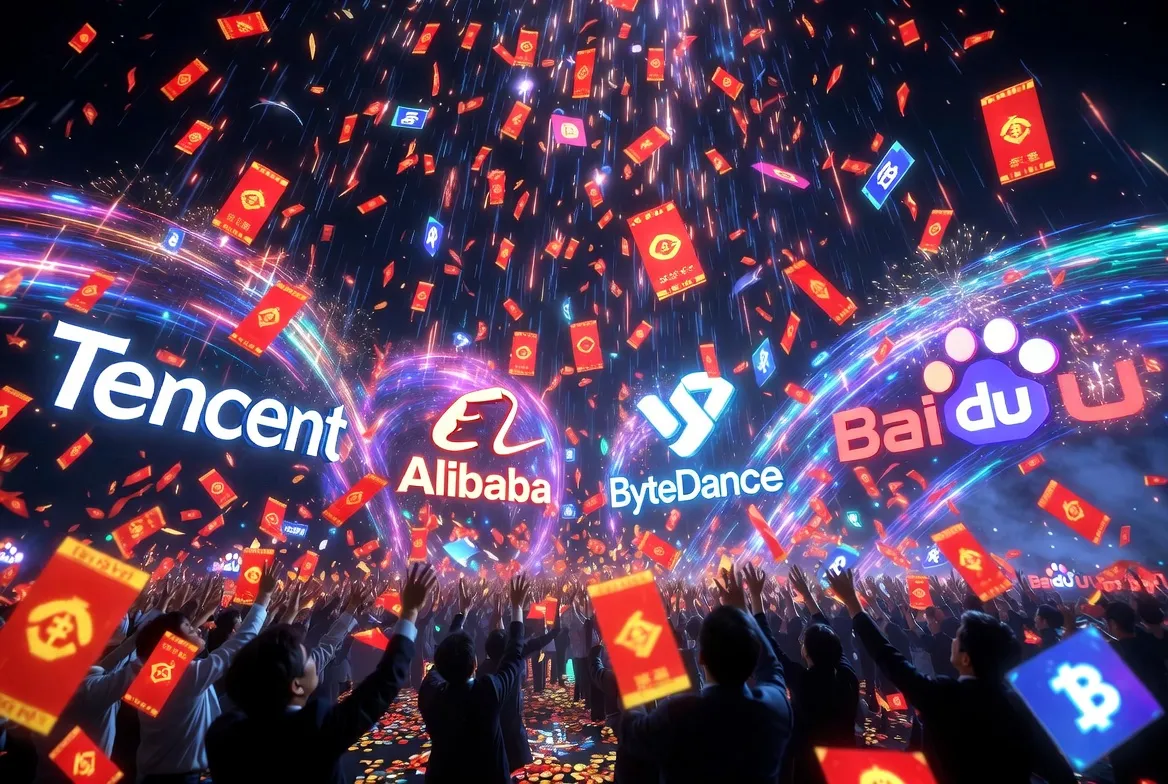
As the 2026 Year of the Horse Spring Festival approaches, China's internet giants have reignited the "red packet war," but this time the battlefield has shifted from pure payment traffic to positioning within AI smart assistant ecosystems. Tencent, Alibaba, ByteDance and Baidu have collectively spent over 600 millions dollars (CNY 4.5B) on red packet, deeply integrating AI through innovative mechanics to capture users' minds during the nationwide reunion holiday and lay the groundwork for the next‑generation super entry point. This "AI red packet war" is not just a marketing carnival but a strategic gamble on the future digital ecosystem; here we examine the fierce competition and its far‑reaching implications.
Origins of the battle: from payment rivalry to a fight for AI entry points
Looking back, WeChat red packets made a breakthrough on the 2015 Spring Festival Gala with the "Shake" feature, overturning Alipay and shaping the mobile payment landscape; the 2020 short‑video red packet wars on Douyin and Kuaishou reshaped the content ecosystem. Today’s 2026 Spring Festival red packet battle features a new element: AI is the core engine. The giants are no longer content with "spending money for traffic"—they are using red packets as a beachhead for AI adoption, fighting over the entry points of the "AI internet" era.
This campaign began on December 23, 2025, when ByteDance struck first: its Volcanic Engine became the exclusive AI cloud partner of the 2026 CCTV Spring Festival Gala, and its AI assistant "Doubao" was deeply embedded in gala interactions, offering AR fortune‑seeking and AI greeting features. Tencent followed, announcing on January 25 that its Yuanbao app would distribute CNY 1 billion in cash red packets, with Pony Ma personally voicing hopes of recreating the WeChat red packet phenomenon from 11 years ago. Baidu's Ernie Bot launched a CNY 500 million red packet activity the same day, tied to Beijing TV's gala. Alibaba made the largest single commitment, announcing on February 2 that the Qianwen app would invest CNY 3 billion to start a "Spring Festival Host Plan." To date, the four giants' total投入已超45亿元, approaching CNY 5 billion, signaling a turning point as AI moves from technical validation to mass application.
Tencent Yuanbao: social virality + CNY 1 billion, chasing the WeChat miracle
Tencent centers on social fundamentals, launching the "Get Yuanbao, Share CNY 1bn" campaign from February 1 to February 17 to cover the entire Spring Festival social peak. Users who log into the Yuanbao app daily can draw lottery rewards; completing AI conversations, generating greeting images, or sharing links unlocks extra chances, with red packets up to CNY 10,000 withdrawable to WeChat Wallet. Tencent is also testing a "Yuanbao Party" group‑chat feature supporting multi‑user, multi‑agent interactions—AI summarizing chats, creating interest check‑ins, and even image‑based "secondary creation"—upgrading AI from a tool to a social participant.
On launch day Yuanbao topped the Apple App Store free charts, surpassing ByteDance's Doubao and demonstrating the power of social virality. Pony Ma said at Tencent's annual meeting that the initiative aims to cultivate a "ask AI first" habit and to violently acquire users leveraging the WeChat ecosystem. Analysts see Tencent's move as a defensive counterattack, using social barriers to fend off potential disruptors.
Alibaba Qianwen: CNY 3 billion "Host Plan," building an ecosystem closed‑loop
Alibaba emphasizes ecosystem integration. The Qianwen app kicked off a CNY 3 billion "Spring Festival Host Plan" on February 2, linking Taobao Flash Sales, Fliggy, Hema, Damai, Tmall Supermarket, Alipay and other services to offer free orders and large cash red packets. Users can instruct AI to "do things in one sentence," such as ordering food, booking tickets, or calling errands, and have a chance to get orders for free, covering real consumption scenarios. Qianwen also exclusively sponsored Bilibili's New Year's Eve show and partnered with major provincial TV galas to integrate AIGC creative capabilities into program interactions.
This approach shifts AI from "being able to chat" to "being able to act," testing AI‑driven shopping and embedding assistants into daily life. Alibaba insiders say the campaign paves the way for year‑round AI positioning as a lifestyle assistant. Goldman Sachs notes Alibaba's CNY 3 billion is the largest single bet in this battle, aiming to build an AI‑driven consumption closed‑loop and occupy high‑frequency life scenarios.
ByteDance Doubao: center‑stage at the gala + interactive play, entertainment‑led penetration
Leveraging entertainment strengths, ByteDance's Volcanic Engine secured the exclusive AI cloud partnership for the CCTV Spring Festival Gala, embedding Doubao into the show to provide AI interactions like real‑time greeting video generation and a card‑collecting event to split CNY 300 million. Douyin's "Collect Auspicious Horse" activity ran from January 26 to February 16, where users collect voice greetings to exchange for cash, up to CNY 2,026. On Lunar New Year's Eve there will be luck‑based pools dividing cash prizes, aiming to use the gala's 1.4 billion viewers for a nationwide AI experience.
ByteDance's strategy is to turn AI from a passive tool into an active participant, using gala traffic to occupy a national‑level entry point. As an AI frontrunner, Doubao uses the moment to consolidate advantages and push entertainment‑oriented applications.
Baidu Ernie: CNY 500 million + multi‑agent group chats, defending the search entry
Baidu's Ernie Bot投入5亿元红包, running from January 26 to March 12, making it the longest campaign. Users interact with AI and collect cards to split prizes, with single red packets up to CNY 10,000. The Ernie app is testing "multi‑user multi‑agent" group chats, invoking assistants like a group‑chat helper and health manager to solve practical problems. Tied to Beijing TV's gala, Baidu pursues a "search + AI" fusion route, upgrading the search box into an AI assistant.
Market impact: retention will be the test, an industry reshape looms
This war is essentially an "experiment in habit formation." The high‑frequency Spring Festival scene can forcibly create AI dependence, but subsidies have very low retention rates and customer acquisition costs may exceed CNY 1,000. NetEconomy analyst Chen Liteng notes that each giant is betting on a different entry: Baidu on search fusion, Tencent on social virality, Alibaba on consumption closed‑loops, and ByteDance on entertainment interaction. Citibank believes 2026 is an AI inflection point and that post‑holiday retention rates will reshape traffic patterns.
For users, this means free AI experiences; for the industry, it is a stress test for AI deployment. In the future, whoever can convert red‑packet users into long‑term users will lead the AI era. Are you ready to join this AI frenzy?
▶️ Enjoyed this article? Creating great content takes effort!
Subscribe to our YouTube channel:
AI Rosetta
Your likes, subscriptions and shares mean the world to us! 🙏
For more AI news, visit:
https://www.airosetta.com