
In 2025 the global IT layoff wave surged. According to Layoffs.fyi and TrueUp, by the end of October 218 tech companies had announced cuts totaling 112,732 jobs, averaging about 580 layoffs per day. Although this is slightly lower than the 152,922 layoffs for all of 2024, attention has shifted to AI‑driven restructuring. Giants such as Amazon, Microsoft, Google and Meta led the cuts, which were concentrated in software development, product management and administrative roles. Fortune and CNBC analyze that this round of layoffs is not simply 'cost‑cutting' but the result of overlapping effects from AI automation and economic uncertainty. While AI is viewed as the 'main culprit', experts note it also creates new opportunities and pushes the industry toward higher‑skilled roles. This article, based on authoritative sources including TechCrunch, Business Insider, Channel Insider, Reuters and Fortune, summarizes major 2025 layoff cases, objectively analyzes causes, AI's impact and future trends, and explores how this 'tech winter' is reshaping the global employment ecosystem.
Layoff Case Summary: Giants 'Slimming Down' Alongside Strategic Adjustments
The major IT company layoffs in 2025 are summarized below (based on Layoffs.fyi and Intellizence reports):
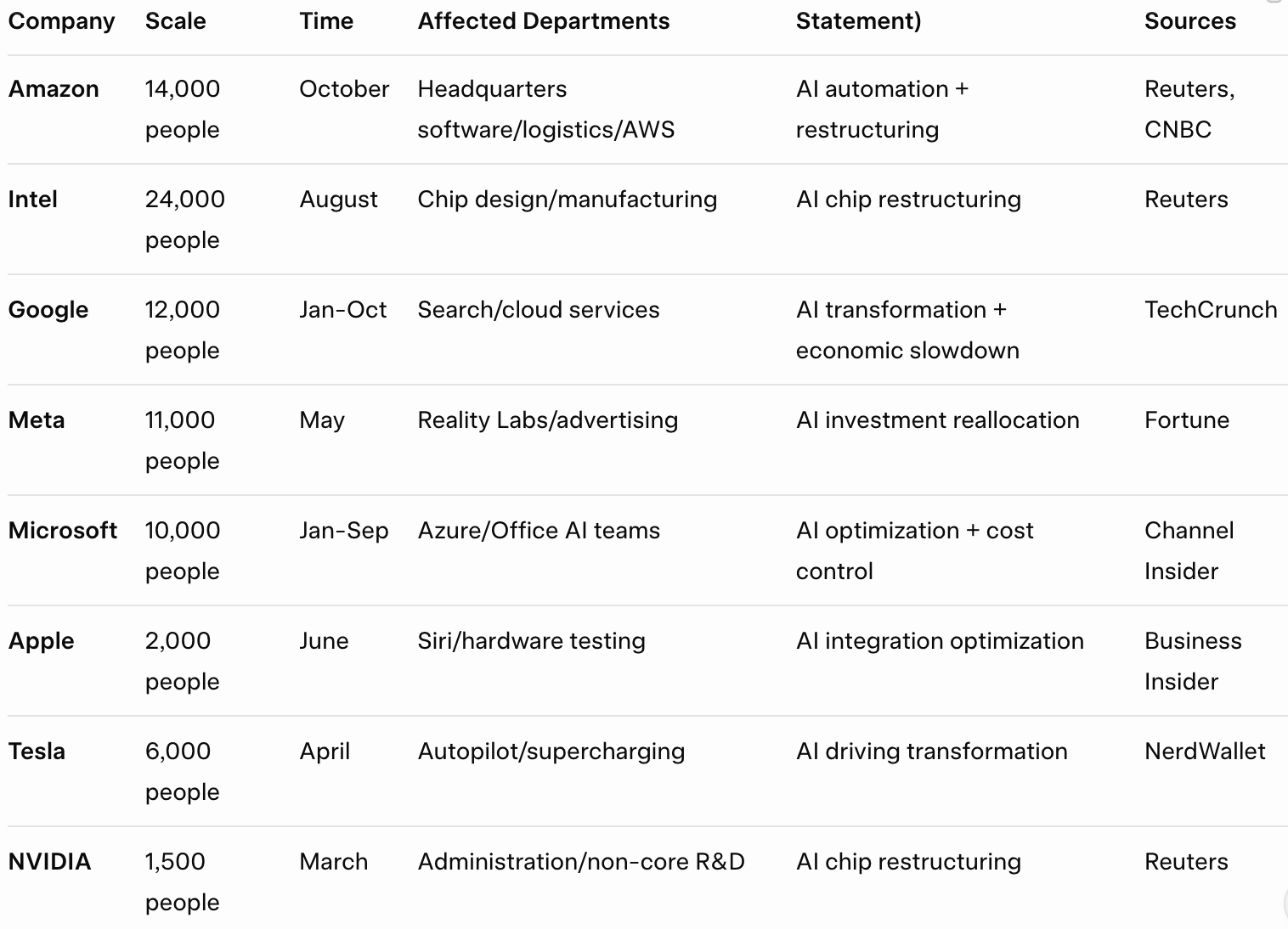
These cases cover more than 80,500 employees at major IT giants, accounting for 71% of the global 112,732 layoffs. TechCrunch's 2025 layoffs list shows Amazon, Google, Microsoft and Intel together account for over 70%.
Objective Analysis of Layoff Causes: Economic Chill + Restructuring Dominant, AI as 'Catalyst'
The 2025 layoffs were not sudden but the result of overlapping macroeconomic weakness and industry transformation. A Reuters report shows global growth slowed to 2.8% (IMF 2025 forecast), while tech giants' capex reached record highs (Meta/Alphabet expected to exceed $70 billion for the year), putting severe pressure on profitability and making layoffs a quick way to 'trim down'.
Main reasons:
- Economic factors: high inflation/interest rates and falling corporate profits. Fortune analyzes that tech sector P/E ratios fell to 25x in 2025, forcing cost controls. Amazon CEO Jassy said the layoffs were a 'cultural adjustment', not a cost issue, but the cuts actually saved $2 billion.
- Restructuring and optimization: post‑pandemic over‑hiring led IT roles to surge 50% from 2021–2023, now 'deflating the bubble'. CNBC reported Microsoft's cuts focused on 'non‑core' Azure teams to reallocate for AI. Intel's 15,000 layoffs were tied to its AI chip transition.
- AI automation: 31% of companies cited AI as a reason for layoffs (Goldman Sachs survey), higher than in October 2024. Channel Insider noted AI is replacing repetitive coding and data analysis roles, putting white‑collar workers on the front lines.
These causes intertwine: economic pressures combined with rapid CAPEX increases accelerate corporate restructuring, and AI provides an 'efficiency excuse'.
AI's Role in Layoffs: Accelerating 'Job Displacement' But Creating a New Ecosystem
AI is not the 'root cause' of layoffs but a 'catalyst'—a Goldman Sachs survey shows only 11% of companies directly laid off workers because of AI, while 31% of tech/media firms were indirectly related. Fortune reported AI automation replaced software development and customer service roles, improving efficiency by 30%, while white‑collar unemployment rose to 4.2% (BLS 2025 data). In interviews with ABC News, experts said Amazon's layoffs 'awakened' corporate AI potential but also created 'fear'—Jassy called it a 'cultural shift', while in practice it optimized logistics and cloud services.
On the positive side: AI creates jobs. CNBC analyzed that AI‑related positions grew 25% in 2025 (data scientists/ethics specialists), with the net effect being 'job substitution' rather than net loss. Reuters noted that after Meta's layoffs, AI content‑moderation roles doubled. However, a Forrester report found 'AI rehiring at lower pay': 50% of laid‑off workers returned in lower‑paid roles with wages falling 20%.
AI's impact is twofold: it disrupts employment structures in the short term while driving skills upgrading in the medium to long term. The World Economic Forum predicts AI will net‑add 97 million jobs from 2025–2030, but 100 million people will need retraining.
Future Direction: After AI 'Growing Pains', the Rise of the Skills Economy
The 2025 layoff wave is not the end but a turning point for AI transformation. Gartner predicts that by 2026 generative AI agents will upend mainstream productivity tools and create a $58 billion market; meanwhile, 50% of organizations will introduce 'AI‑free' skills assessments to counter a decline in critical thinking. McKinsey reports that by 2030 AI could automate 30% of U.S. work hours but will boost productivity for STEM, creative and business professionals, shifting wages toward higher‑paid roles. The World Economic Forum stresses that AI will reshape labor demand, sharply increasing demand for advanced IT, data analytics and creative skills, with net job gains in the tens of millions.
Companies are moving toward an 'AI+human' collaborative model. Although Microsoft cut jobs, its Office of Responsible AI has continued to strengthen; the 2025 transparency report shows red‑team testing covered 67 AI models, emphasizing human oversight and ethical frameworks. Giants accelerated their positions through M&A: AI‑driven M&A value grew 123% in 2025, with Meta and Amazon leading infrastructure acquisitions, and ServiceNow buying Moveworks for $3 billion to bolster AI agents. Big Tech's total capex exceeded $320 billion, fueling a wave of data center, chip and robotics acquisitions.
On policy, the U.S. introduced an AI Action Plan and the Artificial Intelligence and Critical Technology Workforce Framework Act, establishing an AI Workforce Research Hub that prioritizes AI skills development and rapid retraining, covering apprenticeships and federal funding. The EU's DMA does not directly target layoffs but requires gatekeepers to disclose AI data use and ranking fairness, indirectly promoting transparency and preventing AI misuse. If the economy falls into recession, unemployment could rise by 5%, but Gartner expects AI's net job creation to offset losses, with high‑skill roles rising to 25% after 2026. Overall, AI will spawn a 'skills economy': 100 million people need retraining, but 97 million net jobs will be added, and developers will shift toward AI ethics, agent development and related fields.
Conclusion: Layoff 'Growing Pains' Herald a New AI Era
In 2025 global tech layoffs totaled 112,732 people, highlighting the twin pressures of AI automation and surging capex: giants invested hundreds of billions expanding AI infrastructure, margins fell by 5–10%, forcing 'trimming' through layoffs. But this is not the end—it's transformation pain. AI improved efficiency by 30% and shortened development cycles by 45%, displacing many repetitive roles. In the medium to long term, however, it will spawn a 'skills economy': high‑skill positions are expected to increase by 25%, and 97 million net new jobs will be created.
AI's future must be stewarded: companies adopting an 'AI+human' model, Microsoft expanded its ethics team by 30%; policy subsidies will retrain 100 million people, and U.S./EU frameworks will promote transparency. The AI era nurtures new vitality: knowledge‑intensive work will replace labor‑intensive work, opening a new era of prosperity.