
At the end of 2025, major large language model (LLM) vendors worldwide upgraded their model versions, racing for state‑of‑the‑art (SOTA). As of December 15, 2025, the LLM field shows intense global competition. The United States continues to lead frontier model development thanks to substantial investment and technical accumulation, China has excelled in open‑source models and rapid iteration, and Europe’s Mistral AI has stood out with efficient, open approaches. According to Stanford HAI's "2025 AI Index Report", the U.S. holds an absolute advantage in private investment and compute, but the performance gap of Chinese models on benchmarks has narrowed significantly, while Europe leads in multilingual and edge compute models. This article reviews four major U.S. LLM vendors (OpenAI, Google, Anthropic, xAI) and their representative models, five major Chinese vendors (Deepseek、Alibaba's Qwen, Zhipu's GLM, Moonshot's Kimi, ByteDance's Doubao), plus Europe's Mistral, conducting multidimensional comparisons and outlooks. Data are from 2025 benchmark tests such as MMLU, HumanEval and GPQA.
Overview of Four Major U.S. LLM Vendors and Their Models
The U.S. LLM ecosystem is dominated by closed‑source and enterprise applications, with massive investment (U.S. AI investment accounted for over 70% of the global total in 2025). The four major vendors and their latest models are as follows:
- OpenAI (GPT series): the latest GPT‑5.2 (released December 2025), approximately 2 trillion parameters, supports multimodal inputs (text, images, code). Its enterprise market share fell from 50% in 2023 to 25% in 2025, but it remains a leader.
- Google (Gemini series): Gemini 3.0 Pro (released December 2025), about 1.5 trillion parameters, emphasizes multimodality and real‑time search integration. Led by Google DeepMind.
- Anthropic (Claude series): Claude 4.5 Opus (released December 2025), around 1 trillion parameters, focuses on safety and ethical AI. It contributes little open‑source work but leads on coding benchmarks.
- xAI (Grok series): Grok 4.1 (released November 17, 2025), roughly 1.2 trillion parameters (MoE architecture), supports multimodal and real‑time inference. It emphasizes conversational intelligence, emotion understanding and a low hallucination rate (from 12% down to 4%), ranked #1 on the LMArena leaderboard with an Elo of 1465.
Overview of Five Major Chinese LLM Vendors and Their Models
Chinese LLM development has accelerated rapidly. In 2025, the number of open‑source models led globally, benefiting from local data and policy support. The "Five Tigers" (Deepseek, Zhipu, Moonshot, ByteDance, MiniMax, Doubao) dominate the market, but we focus on five major names:
- Deepseek (Deepseek V3.2 series): Deepseek V3.2 (released December 1, 2025), about 685B parameters, open‑source, supports Chinese‑English bilingual and multimodal capabilities. Deepseek shortened its development cycle and approaches U.S. model performance.
- Alibaba (Qwen series): Qwen3 (released summer 2025), about 390B parameters, open‑source, supports Chinese‑English bilingual and multimodal capabilities. Alibaba compressed its development cycle and neared U.S. model performance.
- Zhipu (GLM series): GLM‑4.5 (released July 2025), about 400B parameters, open‑source, strong in coding and scientific reasoning. It ranks highly among HuggingFace open‑source models.
- Moonshot (Kimi series): Kimi‑K2 (released early 2025), around 200B parameters, primarily closed‑source, focuses on long‑context handling and application integration.
- ByteDance (Doubao series): Doubao 1.6 (also called Seed‑1.6, released June 2025), about 300B parameters (MoE‑based), open‑source, supports multimodal capabilities including visual understanding. It ranks first among Chinese models on the SuperCLUE benchmark, averages 164 trillion tokens called per day, excels in scientific and visual tasks, and achieves over 19.43% accuracy on the MME‑SCI benchmark.
Europe's Mistral AI and Model Overview
Mistral AI, representing Europe, emphasizes open‑source and efficient models and secured NVIDIA collaboration in 2025. Latest models:
- Mistral Large 3 (released December 2025), 41B active parameters, 675B total parameters, supports multimodality and a 256k context window.
- Ministral 3: a small model suitable for edge devices such as drones and smartphones.
- Devstral 2: code‑specialized, 24B parameters, scores 68% on coding benchmarks.
Mistral focuses on performance‑to‑cost ratio and models that can run locally.
Comprehensive Comparison: Multidimensional Analysis
The table below summarizes key dimension comparisons based on 2025 benchmarks (such as Arena Elo scores, MMLU, etc.). U.S. models lead in overall performance, Chinese models have clear advantages in open source and cost, and Mistral stands out in efficiency and multilingual capability.
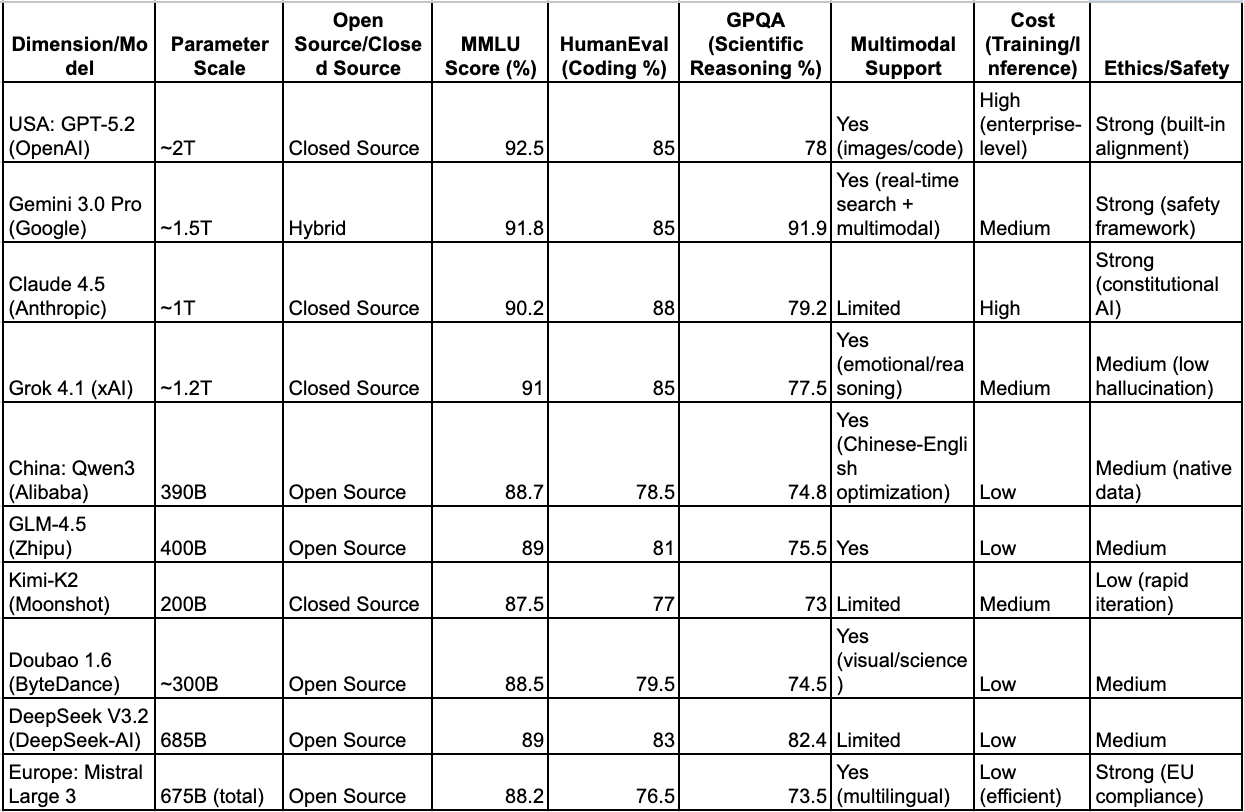
Performance analysis: U.S. models lead on average by 3–5% on MMLU and GPQA, benefiting from massive data and compute resources (e.g., NVIDIA clusters). Grok 4.1 performs strongly in hard reasoning and coding benchmarks, particularly in multi‑step logic and mathematics. Chinese models have rapidly closed the gap; Qwen3 and GLM‑4.5 match Western models on open benchmarks and outperform by over 20% on Chinese tasks; Doubao 1.6 is competitive in vision and scientific reasoning (e.g., MME‑SCI). Mistral Large 3 offers the best performance‑to‑cost ratio, suitable for European privacy regimes (such as GDPR), though it lags slightly in scientific reasoning. Overall, Chinese open‑source models dominate the HuggingFace top 10 (60% share), driving global innovation.
Application scenarios analysis: U.S. models (e.g., GPT‑5.2 and Grok 4.1) dominate enterprise AI (such as code generation and customer service), with rich integration ecosystems. Chinese models (e.g., Doubao 1.6) are optimized for e‑commerce, social platforms and visual applications, excelling at localization. Mistral's Ministral 3 targets edge compute for robots and phones, filling a European gap in mobile AI.
Ethics and geopolitics analysis: The U.S. emphasizes safety (e.g., Claude's constitutional AI and Grok's low hallucination), but faces privacy litigation. Chinese models are influenced by domestic policies and skew toward Asian cultural data, while open sourcing promotes global collaboration. Mistral aligns with EU AI regulations and stresses transparency to avoid "black box" issues. U.S.–China competition intensifies, and China invests in domestic chips to mitigate sanctions.
Outlook: 2026 and Future Trends
In 2026, LLMs will evolve toward multimodality and AGI directions. The U.S. may release GPT‑6 and Grok 5, strengthening real‑time intelligence but facing concerns about diminishing returns in performance gains. China is expected to double its number of open‑source models, with the Qwen and Doubao series challenging U.S. leads on GPQA, aided by critical technology innovation policies. Mistral will expand its Devstral series, and European AI investment is projected to grow by around 30%, focusing on sustainable and ethical AI. Global trends: open source will dominate (with major contributions from China and Europe), cross‑regional cooperation will increase, but geopolitical risks (such as chip export bans) may deepen fragmentation. Ultimately, LLMs will integrate into daily life and drive trillions in economic value, while energy consumption and bias remain key challenges.
▶️ Enjoyed this article? Creating great content takes effort!
Subscribe to our YouTube channel:
Your likes, subscriptions and shares mean the world to us! 🙏
For more AI news, visit: https://www.airosetta.com