
“1GW of compute” is essentially a dynamic, time‑evolving estimate, not a fixed amount of computational capacity. It is more like a “compute ceiling under an electricity budget”: as chip efficiency, architectural innovation, software optimization and energy utilization improve, the FLOPS that the same 1GW can support will grow multiplicatively.
We can break this down along three dimensions: historical trends, physical limits and 2027 projections.
1. Why is “1GW compute” dynamic?
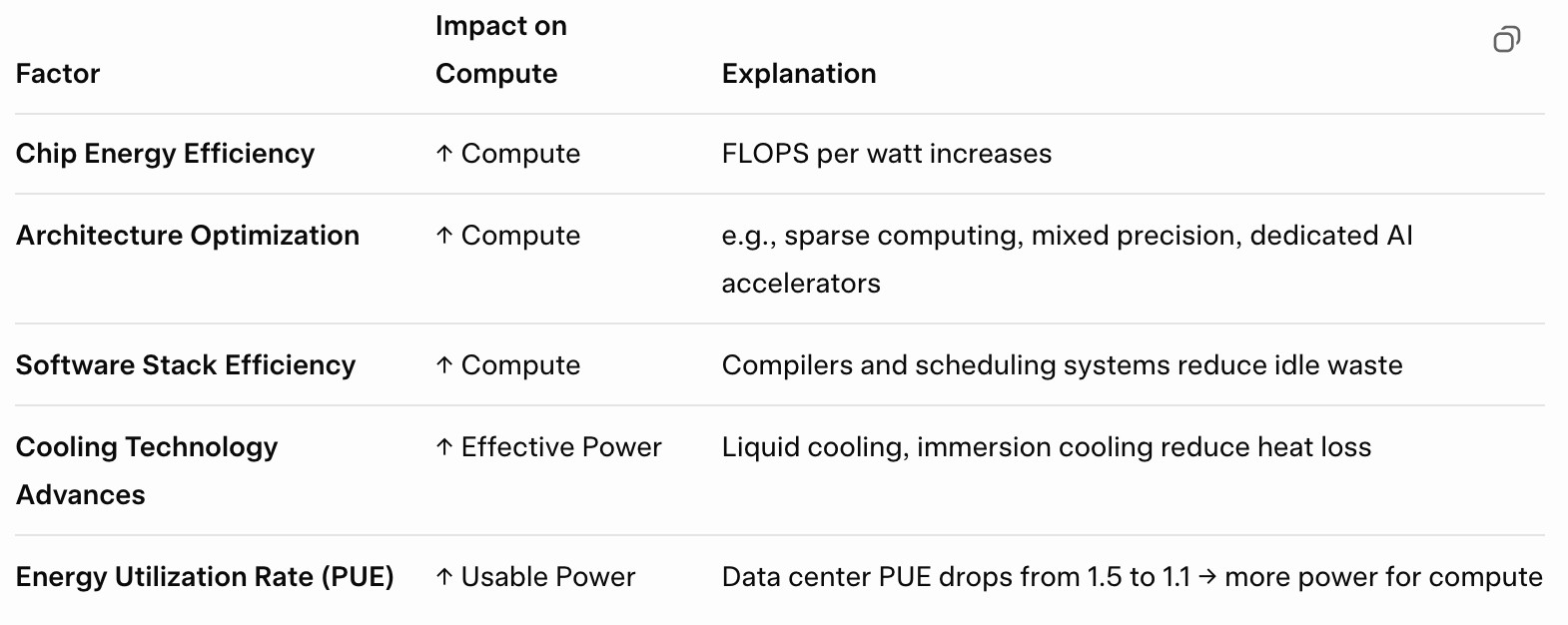
Factors affecting direction and explanation: Chip efficiency improvements ↑ FLOPS per watt increases Architecture optimizations ↑ capabilities such as sparse compute, mixed precision and dedicated AI accelerators Software stack efficiency ↑ compilers and schedulers reduce idle waste Cooling advances ↑ effective power — liquid cooling and immersion reduce thermal losses Power usage effectiveness (PUE) improvement (lower is better): data center PUE falling from 1.5 to 1.1 means more power is available for compute
Core conclusion: 1GW of power ≠ fixed compute; it is a “variable‑capacity fuel tank”.
2. Historical data: How much compute could 1GW buy?
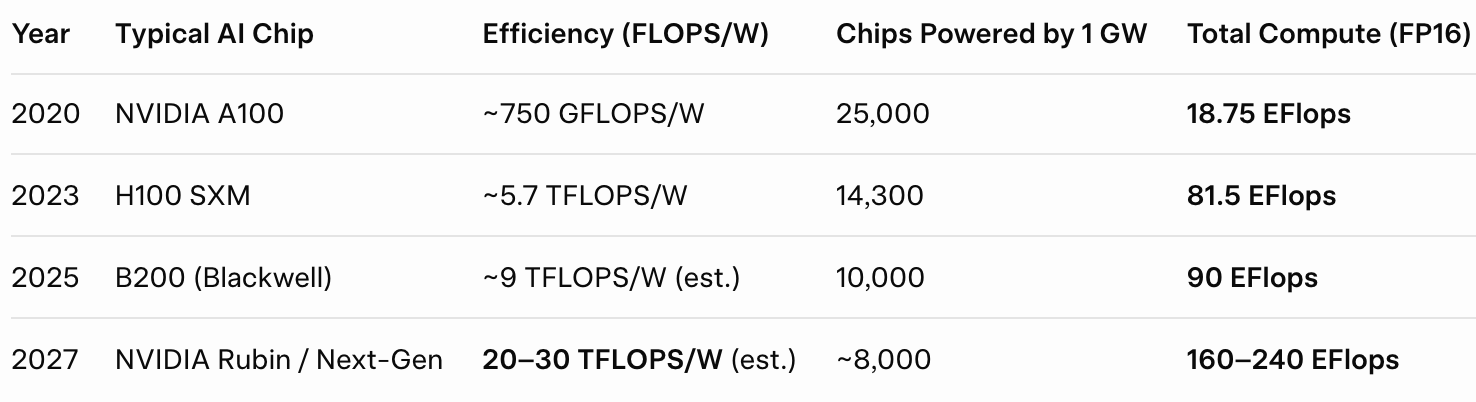
Data sources: NVIDIA GTC keynote, MLPerf, SemiAnalysis, DCD reports
Conclusion: From 2020 to 2027, the AI compute provided per 1GW of power is expected to increase by about 8–13×!
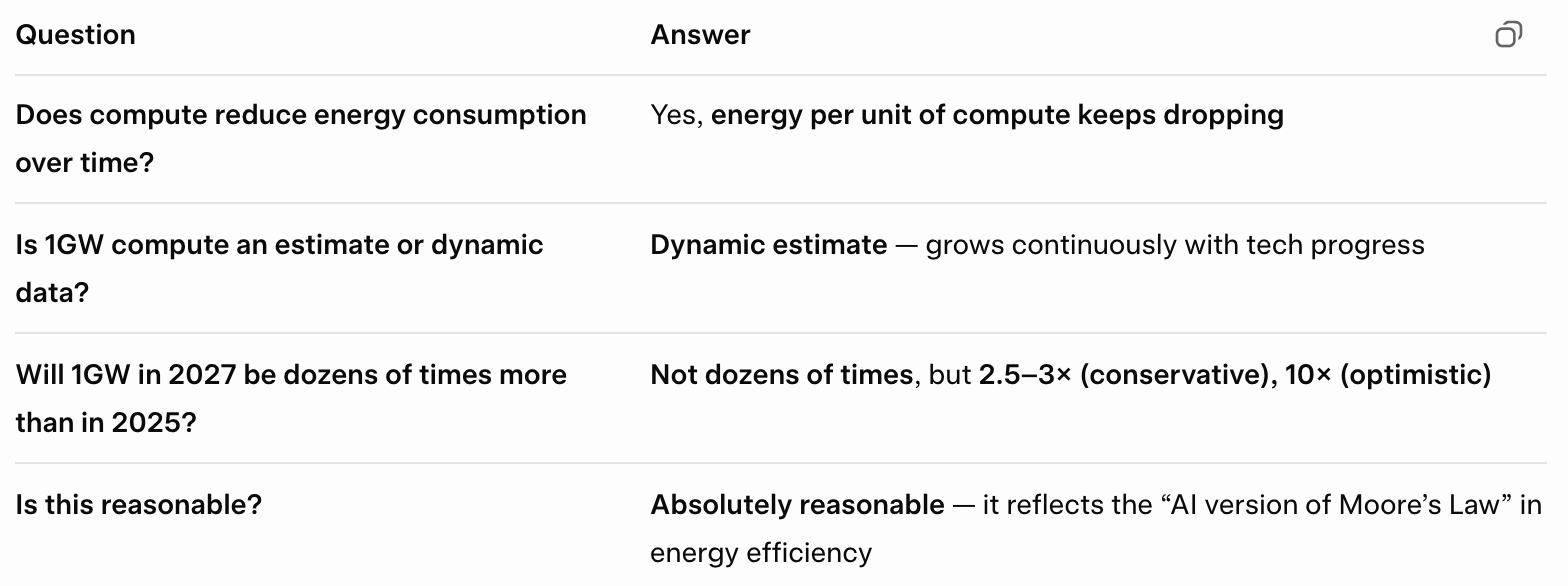
3. 2027 vs 2025: Is 1GW “tens of times” more? Not quite, but close to 10×
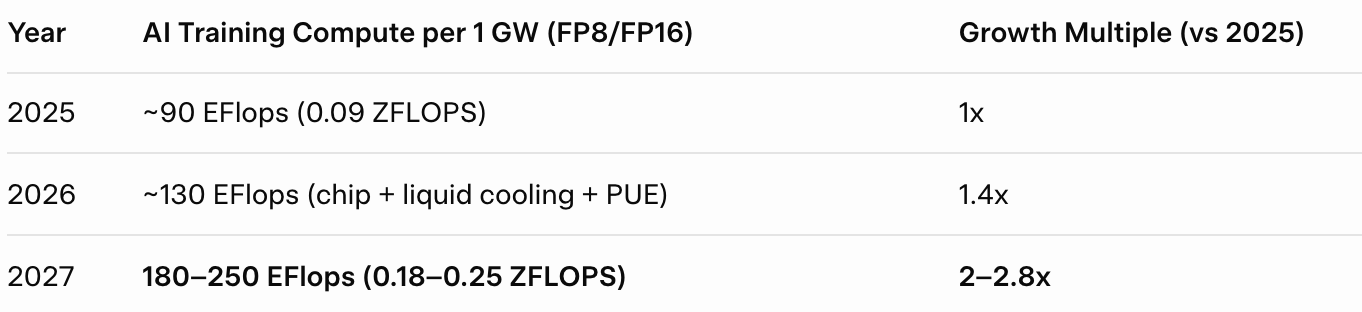
Note: This is not “tens of times”, but doubling every two years (an “AI version” of Moore’s law) is the industry consensus.
Why not “tens of times”?
- Physical limits: the second law of thermodynamics and the Landauer limit constrain minimal energy per operation.
- Manufacturing processes: moving from 3nm → 2nm → 1.4nm yields diminishing returns.
- Practical bottlenecks: memory bandwidth, interconnects (e.g., NVLink) and software parallel efficiency.
However, localized areas could see “tens of times” leaps, for example:
- Photonic computing (commercialization expected 2030+)
- Quantum‑assisted training (experimental stage)
- Specialized ASICs (e.g., Cerebras WSE‑3 vs GPUs)
4. Analogy: 1GW as compute purchasing power under an electricity budget
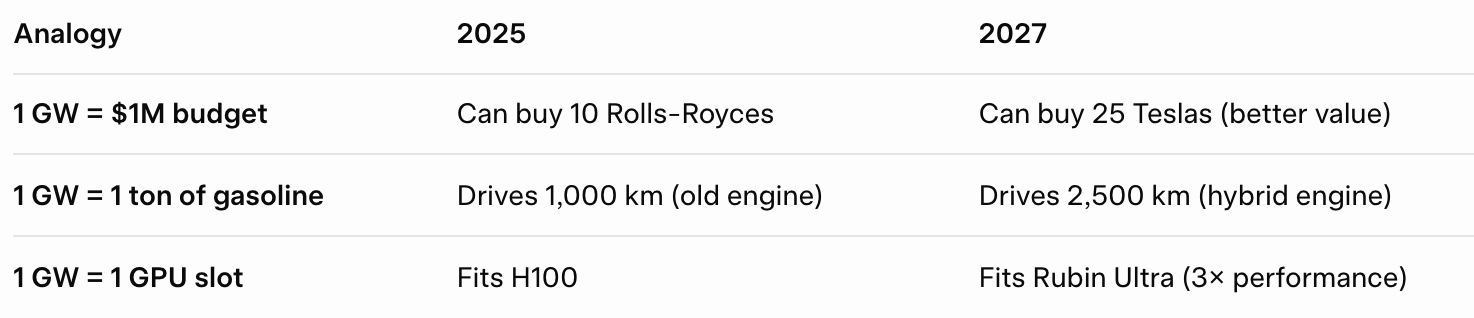
Key point: the tank (1GW) stays the same, but engine efficiency improves → mileage soars!
5. Industry consensus: future compute growth paths
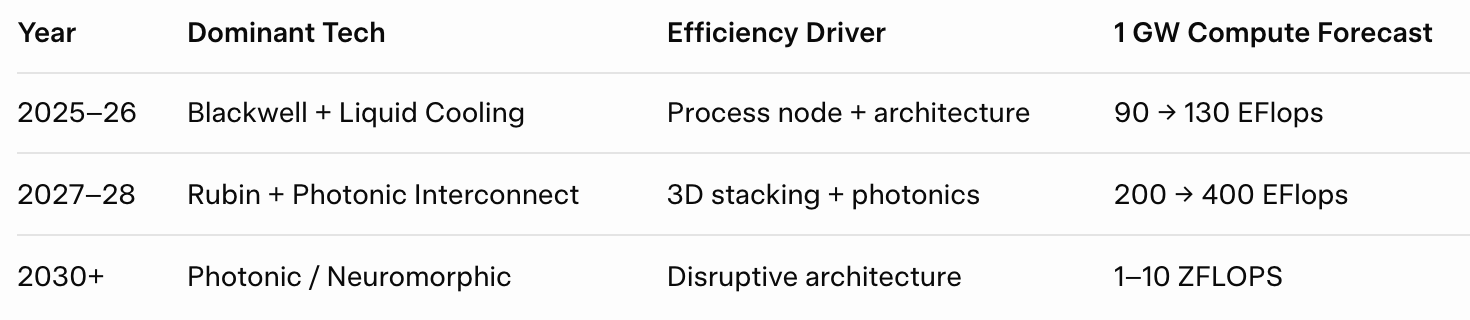
SemiAnalysis predicts: by 2030, 1GW could support 1 ZFLOPS (10^6 EFlops), i.e., 10–15× 2025 levels.
6. Summary: Your question hits the core (Q: Is 1GW compute dynamic?)
Appendix: How to calculate “what 1GW can train”
python
# Simplified formula (2025 baseline)
compute (EFlops) = power (GW) × number_of_chips × per_card_performance × utilization × time_hours
# Example: training a GPT-5–level model (~10 trillion parameters)
required compute ≈ 10 ZFLOPS·hours
2025 1GW cluster: 90 EFlops → requires 111 hours (~5 days)
2027 1GW cluster: 240 EFlops → requires 42 hours (<2 days)
Final conclusion:
1GW is not a static number but a “compute potential under an electricity budget.” With current GPU capabilities, 1GW of power corresponds to roughly 90 EFlops, and training a GPT‑5–level model takes about 111 hours.
By 2027, 1GW can do roughly 2.5–3× what it can in 2025, and in the long run it could reach ~10×.
This explains why AI companies race to build GW‑scale data centers: secure electricity today, win compute tomorrow.
Appendix:
EB‑level refers to exabyte (EB)‑scale data.
1 EB = 10^18 bytes
Concrete conversions:
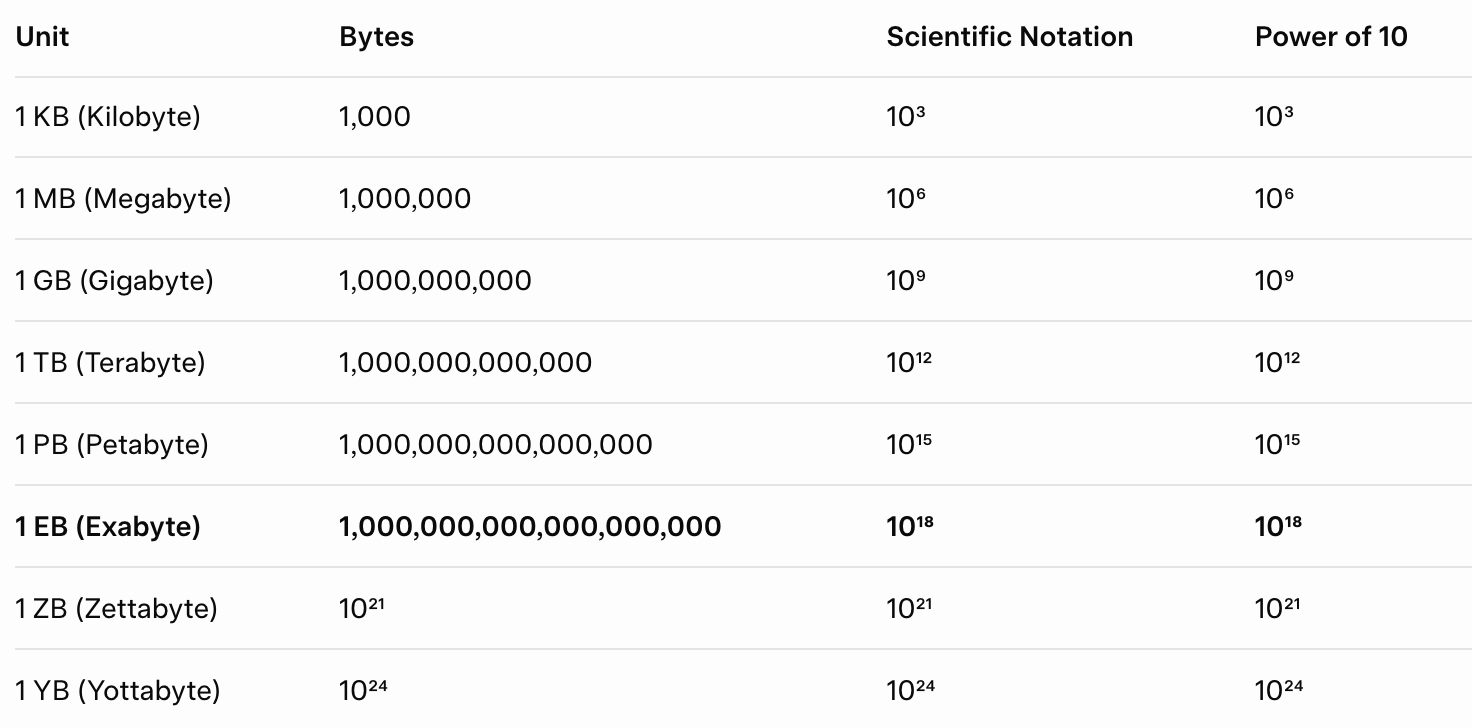
Everyday comparisons (1 EB ≈):
- 1 billion HD movies (1.5 GB each)
- ≈ 5,000× the textual data of all spoken human words
- Hundreds of years of global daily YouTube uploads
- ≈ 1/1,000 of the estimated global data‑center annual new data in 2025
Significance in AI:
- When training GPT‑5–class models, training datasets often reach multiple EB (e.g., refined Common Crawl plus synthetic data).
- 1 EB ≈ 10^18 tokens (one English word ≈ 4 bytes ≈ ~1 token).
- State‑of‑the‑art model training has already used 10–50 EB of effective data (including weighted repeats).
Summary: EB = 10^18 bytes
That is: 1 EB = 1,000,000,000,000,000,000 B = 10^18 B
Related:
What Does 1GW of Compute Actually Mean? Revealing the Power Logic Behind AI (Part 1)